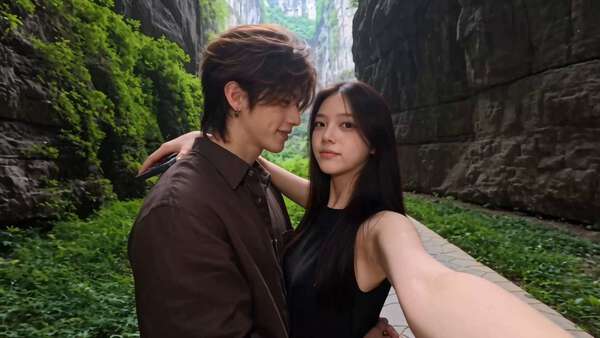
Travel Kisses Across Famous Landmarks
浪漫吻遍山河🌹💋💋 by Seedance 2.5 🎬 prompt 👇 https://t.co/1pMyusJW8f ----- Prompt (recovered from author's thread reply 2118685808043446747) ----- SEEDANCE 2.5 / 吻遍山海 / 双人旅行亲吻导演提示词 Du…
オープンソース の素晴らしい動画プロンプト集 · 7,786件収録
Character sheet of the woman from the reference photos — the same person shown in every provided image. Take her look, skin texture and fine detail primarily from the sharpest close reference photo - <<<image_2>>>, the one where she sits against the limestone block with one knee raised, one hand resting on top of her head wrap, looking off to the side; use the other photos only as supporting angles. Preserve her exact facial identity, bone structure and hair shape from the references — do not restyle or idealize her: long dark brown loosely wavy hair, falling out from under the head wrap past the chest and framing the face in loose strands, faint natural lighter-brown tones through the lengths, warm sun-tanned olive skin with a natural sun flush across the nose and cheeks, light freckles and a faint natural sheen, a small dark mole on her right cheek, warm dark-brown eyes with long natural lashes and no liner, dark-brown brows with natural fullness and a soft arch, soft full cheeks, a straight nose with a softly rounded tip, full lips with a natural rosy-nude tone, and a soft defined jaw. Slim, fit build. Silver rings as seen in the references: a large round silver ring with a golden-amber centre on her left hand, and on her right hand a domed silver ring with a pale pearl-like centre plus a slim gold-and-silver band. Keep her natural asymmetry, faint skin texture and any small variation from the references.
Vertical 9:16 frame divided into an even 2×2 grid of four views of the same person. Top left, top right and bottom left are close-up head-and-shoulders views cut at the upper chest, all three at identical head size, identical eye-line and identical camera distance: top left, front view facing the lens; top right, her left-side profile; bottom left, her right-side profile. The bottom right quadrant is different — a front-facing full-body shot showing her entire outfit and slim, fit figure from shoulders down to the feet, framed so the top of the frame cuts across at the neck and the head is not included, with the full length of the robe down to the floor line visible and clean floor space beneath. Same neutral posture throughout — head level in the three portraits, shoulders relaxed and square, calm neutral expression, lips lightly closed, gaze straight ahead; standing relaxed and upright in the full-body view, arms resting naturally at her sides, feet planted flat, roughly shoulder-width apart.
Wardrobe identical across all four views, exactly as in the reference photos: the same cream off-white head wrap from the references, soft crinkled cotton gauze wound around the head as a turban with the crown covered, its long tail draped down around the neck and loosely over the shoulders like a scarf, her hair falling out from underneath. Worn with the same oversized ivory-cream lightweight cotton robe from the references, wide open draped sleeves, loose and unstructured with soft natural folds, falling full-length to the top of the feet. On her feet, the flat dark-brown leather sandals from the sandal reference photo, with a toe loop, a wide crossover strap and a pale sage-cream leather panel with brown geometric patchwork stitching, almost entirely hidden by the length of the robe, only the toes and the front edge of the sandals showing beneath the hem. Full-length outfit shown in the full-body quadrant.
Seamless off-white studio backdrop, large soft frontal key with gentle fill from both sides, neutral white balance, soft shadow falloff under the jaw and a soft contact shadow beneath the hem and sandals. 85mm lens at eye height for the portraits and a matching clean full-length framing for the body shot, no distortion, clean headroom in each quadrant, sharp throughout.
Realistic skin with natural texture and tone variation, faint natural blemishes and asymmetry kept, hair reading as separate strands rather than a smooth mass, visible crinkled gauze weave and layered folds on the head wrap and scarf, visible soft cotton drape and fine creasing on the robe, visible leather grain and stitching on the parts of the sandals that show. No retouching or smoothing, no beauty lighting, no glamour styling, no stylization. No text, labels, borders or watermarks.
----- Prompt (recovered from author's thread reply 2112515421769519234) -----
step 2: same thing for the second character
one clear photo of face Character sheet of the man from the reference photos — the same person shown in every provided image of him. Take his look, skin texture and fine detail primarily from the close car-seat selfie and the four-view studio sheet; use the remaining photos only as supporting angles. Preserve his exact facial identity, bone structure, hairline and hair shape from the references — do not restyle or idealize him: very short bleached platinum-blond buzz cut, cropped close and even all over with a clean straight hairline, warm tanned olive skin with a faint natural sheen across the forehead, nose and cheeks, hazel-brown eyes with a slightly heavy-lidded gaze, thick dark near-black brows, straight and full with natural stray hairs, broad cheekbones, a straight nose with a softly rounded tip, full lips with a natural muted pink tone, light dark stubble on the upper lip and chin, a strong square jaw, a thick muscular neck, and a few small faint marks on his right cheek. Lean, athletic build. No jewellery and no watch. Keep his natural asymmetry, faint skin texture and any small variation from the references.
Vertical 9:16 frame divided into an even 2×2 grid of four views of the same person. Top left, top right and bottom left are close-up head-and-shoulders views cut at the upper chest, all three at identical head size, identical eye-line and identical camera distance: top left, front view facing the lens; top right, his left-side profile; bottom left, his right-side profile. The bottom right quadrant is different — a front-facing full-body shot showing his entire outfit and lean, athletic figure from shoulders down to the feet, framed so the top of the frame cuts across at the neck and the head is not included, with the full length of the sandals visible and clean floor space beneath. Same neutral posture throughout — head level in the three portraits, shoulders relaxed and square, calm neutral expression, lips lightly closed, gaze straight ahead; standing relaxed and upright in the full-body view, arms resting naturally at his sides, feet planted flat, roughly shoulder-width apart.
Wardrobe identical across all four views: a loose ankle-length undyed sand-beige linen tunic with a simple band collar and a short placket of three small wooden buttons, worn under a sleeveless open-front charcoal-brown wool overvest that falls to mid-thigh, with raw hand-stitched edges and slightly frayed hems. Around his waist, a wide rust-terracotta woven cloth sash wrapped twice and knotted at the left hip, its ends hanging to the knee. Around his neck, a loosely wrapped faded indigo cotton scarf with a thin cream stripe pattern, its ends tucked under the vest. On his feet, the flat dark-brown leather sandals from the sandal reference photo, with a toe loop, a wide crossover strap and a pale sage-cream leather panel with brown geometric patchwork stitching, worn on bare feet. Full-length outfit shown in the full-body quadrant.
Seamless warm sand-beige studio backdrop, large soft frontal key with gentle warm fill from both sides, slightly warm white balance, soft shadow falloff under the jaw and a soft contact shadow beneath the sandals. 85mm lens at eye height for the portraits and a matching clean full-length framing for the body shot, no distortion, clean headroom in each quadrant, sharp throughout.
Realistic skin with natural texture and tone variation, faint natural blemishes and asymmetry kept, hair reading as separate short bristles rather than a smooth mass, visible slub weave and natural wrinkling on the linen, visible coarse wool texture and hand stitching on the vest, visible woven ridges on the sash, soft fading on the indigo scarf, visible leather grain and stitching on the sandals. No retouching or smoothing, no beauty lighting, no glamour styling, no stylization. No text, labels, borders or watermarks.
----- Prompt (recovered from author's thread reply 2112515439024812464) -----
step 3: the opening frame
attach her character sheet and paste this. this becomes the first frame of your video 👇
Create an ultra-realistic editorial travel portrait using two reference images.
IMAGE A: my character reference. Use Image A only for the identity of the person — preserve the exact face, facial structure, skin tone, eyes, lips, nose, hair, and overall recognizable appearance of my character.
IMAGE B: the Giza pyramid portrait reference. Use Image B for the exact composition, pose, styling, location, lighting, mood, lens feeling, film look, color treatment, wardrobe, and vintage editorial aesthetic.
Generate a highly realistic portrait of my character seated in the exact same pose and composition as the woman in Image B, in front of the Great Pyramid of Giza. She is seated on the ground among pale, weathered limestone blocks and dusty sand, with one knee raised toward the camera. One hand rests softly across the raised knee, showing delicate rings, while the other hand is placed over the top of the headscarf to block the sunlight from her eyes. Her expression is calm, introspective, slightly distant, and natural — not smiling, not overly posed, just quietly thoughtful.
The location must feel exactly like the Giza plateau: dry desert air, ancient limestone blocks, sandy beige ground, archaeological rubble, and the Great Pyramid rising massively in the background. The pyramid should dominate the upper background with visible stone texture and a natural sense of scale. Keep the framing intimate and editorial, with the subject large in the frame and the pyramid tightly behind her.
Wardrobe: soft ivory/off-white flowing desert clothing made of lightweight cotton or gauze-like fabric. A loosely wrapped ivory headscarf drapes around the head and neck in soft natural folds. A loose off-white robe or galabeya with wide sleeves flows around the body. The clothing should feel airy, elegant, timeless, and slightly bohemian, with realistic wrinkling and subtle fabric translucency where light passes through. Long dark brown hair falls naturally from beneath the scarf over the shoulders and chest.
Accessories: include delicate rings on the fingers, especially a larger silver ring visible on the hand resting on the knee and another statement ring on the hand placed on the headscarf. A worn brown leather travel bag should appear partially visible in the lower right corner.
Lighting: match Image B precisely. Strong natural late-afternoon desert sunlight coming from camera-left/front-left, creating a warm, sun-baked glow on the subject’s skin and clothes. The lighting should create soft but defined shadows, especially under the hand placed on the forehead and in the folds of the robe. Highlights should feel slightly bright and sun-faded, but not harshly blown out. The skin should have natural luminous warmth, with slight specular highlights on the nose, cheeks, and forehead from heat and sunlight. The scene should feel hot, dry, and naturally sunlit.
Color and grading: recreate the exact old-film editorial look of Image B. Use a soft faded analog color palette with warm desert beige, dusty cream, muted tan, sun-washed ivory, soft brown, and subtle blue-gray shadows. Add a slightly vintage film look with low contrast, gentle haze, softened micro-contrast, slight grain, a lightly faded black point, subtle warmth in skin tones, and a nostalgic analog texture. The image should feel like a 35mm or medium-format fashion-travel editorial shot scanned from film. Keep saturation slightly muted and natural. Avoid bright digital colors. The overall filter should feel cinematic, old, dreamy, dusty, and authentic.
Lens and composition: medium close portrait, vertical framing, around 4:5 aspect ratio. Eye-level angle. Natural environmental portrait composition. The subject should fill most of the frame, with the pyramid tightly visible behind her. Keep the perspective realistic, similar to a 35mm or 50mm lens. Do not make it look like a wide-angle tourist snapshot; it should feel like a carefully composed editorial portrait.
Texture and realism: preserve realistic skin texture, subtle pores, natural flyaway hairs, real fabric folds, dusty air, slight atmospheric softness, and authentic stone textures. The final image must feel like a real photo, not AI-generated. Keep the face highly accurate to my character reference while maintaining the exact style and atmosphere of the pyramid reference.
Mood: timeless, quiet, sun-drenched, slightly mysterious, elegant, desert-travel editorial, ancient-world atmosphere, soft vintage sophistication.
Important priority order: 1. Preserve my character identity exactly from Image A. 2. Match the exact pose, styling, and composition from Image B. 3. Match the exact old-film color grading, faded filter, and warm desert lighting from Image B. 4. Keep the final result photorealistic and natural.
Negative prompt: modern glossy retouching, oversaturated colors, HDR look, sharp digital look, plastic skin, fake fashion studio lighting, cartoon look, 3D render, extra fingers, distorted hands, bad anatomy, incorrect pyramid shape, crowded tourists, modern city elements, text, watermark, heavy blur, overly orange skin, extreme contrast, unnatural symmetry, beauty-filter face, artificial eyes.
----- Prompt (recovered from author's thread reply 2112515458691903645) -----
step 4: the ending location
no people needed here. just the place the video ends 👇
4:3 tourist photo at Giza. The Pyramid of Khafre centred, hazy blue-white sky. Foreground: three camels kneeling in the sand with red woven saddle blankets and coloured tassels, a fourth saddled camel standing at the right edge, cropped. Rubble and hoof-scuffed sand.
High midday sun, short hard shadows, washed-out sky near the horizon. Compact digital capture, fine noise, slight barrel distortion.
----- Prompt (recovered from author's thread reply 2112515474508640736) -----
step 5: the video (Shoot 1)
open seedance 2.5 in Fishcreative and upload all 4 images: 1. the opening frame 2. the camel location 3. her character sheet 4. his character sheet
then paste the full prompt below 👇
=== REFERENCE MAP === - @[Image 1](image_1) (hook frame) → opening composition and pose; the woman's face, hair, skin, loose cream-white gauze clothing, head wrap, rings and brown leather bag; pyramid location, light and camera look. It does NOT set the weather: its air is still, the video is windy from the first frame. - @[Image 2](image_2) (camels at the pyramid) → setting of the final scene (kneeling camels in front of the pyramid); look of all camels, halters, tassels and saddle blankets. Its air is also still — the video adds the same wind, blowing sand and haze. - @[Image 3](image_3) (woman character sheet) → the woman's face from the front and both profiles, hair length and wave, freckles, the crinkled gauze head wrap with its long tail, the wide-sleeved open robe and her full-length look. - @[Image 4](image_4) (George character sheet) → George's face and identity, his head from the front and both profiles, his full outfit and his sandals. - @[Image 3](image_3) and @[Image 4](image_4) define people and clothing only: ignore the plain studio backdrops, studio lighting and grid layout. Where @[Image 1](image_1) and @[Image 3](image_3) differ in pose, light or setting, @[Image 1](image_1) wins. === RUN ORDER === All five shots are mandatory, in this order. Shots 1–4 are over by 12.0 s; the last four seconds belong to Shot 5, and the video ends on it. 1. 0.0–8.0 s — she talks to the person filming; whip turn and zoom to George: "But I will." 2. 8.0–9.3 s — camel's foot on the sand, side view 3. 9.3–10.7 s — neck-mounted camera looking up at her 4. 10.7–12.0 s — rig in front of the camel's head 5. 12.0–16.0 s — match cut on the camel's head; pull back, turn left; George waters the camel: "So stay till the end." === GLOBAL — APPLIES TO EVERY SHOT === - WEATHER, in every frame of all five shots: wind 20–25 km/h, moderate but sharp, in irregular pulsing gusts — a new wave every few seconds — never hiding the sun. Every shot visibly shows (1) the gusts, (2) a medium-density layer of sand flowing fast across the ground like mist, (3) fine airborne dust, (4) a slightly hazy background that still keeps its colour and detail. No shot has still air. - FABRIC: the woman's and George's clothing behave like lightweight cotton and linen — visibly fluttering and billowing whenever in frame; in stronger gusts pressing briefly against the body while the loose ends whip through the air. Her gauze wrap tail and wide sleeves, his indigo scarf ends and the long fringed ends of his rust sash all move. His wool vest is heavier: it flaps at the edges but never billows. Loose hair, tassels and fringes move too. - LOOK: 4:3 landscape, as @[Image 1](image_1) and @[Image 2](image_2). Candid handheld footage: hard desert sun, deep depth of field, fine sensor noise, no colour grade, no beauty smoothing. Real skin: pores, freckles, sweat sheen, sun-flush, fine dust on skin, hair and fabric. No large blown-out white areas. - SPEED / TEXT: normal speed in every shot — no slow motion, no speed ramps. No music, no captions, no on-screen text. - WOMAN: exactly as @[Image 1](image_1) and @[Image 3](image_3) — softly rounded face, warm hazel-brown eyes, light freckles across the nose and cheeks, small dark mole on her right cheek, long loosely wavy dark-brown hair with lighter sun-streaked lengths falling out from under the wrap; cream crinkled cotton-gauze head wrap wound as a turban with its long tail draped around the neck; oversized open ivory-cream gauze robe with wide draped sleeves. Rings exactly as @[Image 1](image_1): a large round silver ring with an amber-brown centre on her left hand; a domed silver ring with a pale pearl-like centre plus a slim gold-and-silver band on her right hand. - GEORGE: face, head, outfit and sandals exactly as @[Image 4](image_4) — short dark-brown hair, textured and swept slightly up and to the side, thick straight dark brows, warm brown eyes, olive skin, a neat short dark beard and moustache, defined jaw. Outfit: long undyed sand-beige linen tunic with a band collar and three small wooden buttons; sleeveless dark-brown rough wool vest with raw hand-stitched edges; faded indigo cotton scarf with thin cream stripes wrapped close around the neck; wide rust-red woven sash knotted at the hip with long fringed ends. Sandals: flat dark-brown leather with a cream panel and brown geometric pattern on bare feet, visible whenever his feet are in frame. No watch, no jewellery. - CAMELS: pale sand-coloured dromedaries dressed as in @[Image 2](image_2). The camel in Shots 2–5 looks like the centre camel of the three kneeling camels in @[Image 2](image_2) (facing the lens, dark rope halter with a teal-and-yellow tassel, red patterned saddle blanket over a wooden saddle frame) and is identical on both sides of the match cut. - CAMERA: Shots 1 and 5 are handheld from first frame to last — constant hand tremor and drift, small late corrections, never locked off, frozen or stabilised. Shots 3 and 4 are fixed to the camel and move with its walk. Shot 2 rests on the sand. - SOUND: one raw location recording from the handheld device's built-in microphone — it sounds like an actual phone recording made outdoors in a windy desert. Wind is audible in every shot: a low rumble, uneven gusts buffeting the microphone, and the faint high tick and rustle of sand grains on the device, like rice being poured. Never polished, isolated, noise-cleaned, overprocessed or studio-sounding. A voice's loudness and clarity follow the speaker's real distance from the microphone. Voices are slightly muffled with a faint open-air echo; every word stays understandable. - HEADINGS: 90° = the direction the lens points in the reference frame (@[Image 1](image_1) in Shot 1, @[Image 2](image_2) in Shot 5). Right turns count down (330° = right and slightly behind). Left turns count up (180–210° = directly left to slightly behind left). PART 1 — SHOT BREAKDOWN (16.0 s total, 5 shots, normal speed throughout) SHOT 1 (0.0–8.0 s) — Hook: she speaks, the camera whips to George - EFFECT: handheld walk-in (two steps) + whip pan right (~120°) + quick unstable zoom-in + subtle lens flare - 0.0 s — framing, pose and light match @[Image 1](image_1): she sits against the limestone blocks with the pyramid behind her, her left hand resting on top of her head wrap, her right hand on her raised knee, the brown leather bag slumped in the sand at lower right. Unlike @[Image 1](image_1), the air is already moving. - WIND, visible from the first frame: sand streams like mist across the ground beside and behind her; fine dust blows through the air between her and the lens; the pyramid is slightly hazy. Her wide sleeves billow and snap, the wrap tail flutters, loose strands of hair move. In the stronger gusts her clothing presses against her body while the loose ends whip. Her body stays relaxed and responsive to the wind. - 0.0–2.0 s — the operator takes about two slightly unsteady steps toward her; each footfall bumps the frame, the framing tightens a little and drifts. Both her hands stay in frame. - VOICE (0.3–5.6 s): slightly raspy, with a light, natural British accent. She sounds engaged, slightly amused, and affected by the heat and wind — casually sharing an observation with the person filming, her eyes coming to them as she starts. No presenter voice, no rehearsed advertising delivery. Her breathing, pitch, volume and pace change naturally as she talks: some words run quickly, others carry more weight, with small audible breaths. She projects a little more through a gust, then relaxes her voice as it passes. - "No one is telling you how to make your AI look like this." — a spontaneous remark to someone nearby. She begins casually and becomes more animated toward "look like this", with a small eyebrow lift and an easy head movement; her free hand lifts loosely off her knee. - "The skin, dust, that harsh desert sun..." — runs straight on from the first sentence. On "The skin" she sweeps her palm lightly across her cheek in one continuous motion while she speaks — no stop, no pose, no demonstration. - On "dust" she lowers the hand from the top of her head wrap and opens BOTH hands outward toward the space around her, loosely indicating the surrounding desert and the sand in the air; her rings catch small glints of sun. - On "that harsh desert sun" she uses a different gesture: one hand makes a broader outward sweep toward the sunlit surroundings, her wrist and head moving with the words. "HARSH" gets strong, natural emphasis — she squints briefly and sounds as though she can physically feel the sun. The phrase has deliberate, expressive timing, voice, hand and head underlining it together, yet stays conversational and slightly irregular — never a rhythmic recital. - RECORDING: at 0.0 s the camera is about two metres from her and her voice is noticeably quieter and less distinct beneath the wind. As the operator physically takes two steps closer, her voice becomes noticeably louder and easier to hear, following the real distance to the microphone. The roughness stays: wind buffeting the microphone, uneven gusts, audible breaths, small fluctuations in vocal clarity, a word drifting slightly downwind when she turns her head. Understandable, never clean. - WIND SOUND: audible through the entire shot. It eases briefly, then builds again in irregular, pulsing gusts. It never disappears between words or during dialogue. She has finished speaking by 5.6 s. - 5.6–6.6 s — one second with no dialogue. Only after her last word, the operator swings the camera fast to the right, about 120° (from the 90° heading to 330°), tilting up slightly and zooming in at the same time; sand and sky streak into motion blur. The zoom is quick and slightly unstable, with small framing corrections: it overshoots a little and comes back while focus catches up. This is SIGNATURE VISUAL EFFECT #1. - The turn reveals George sitting on a standing camel a few metres away — directly in front of the woman, in the direction she was looking in @[Image 1](image_1), in the space that was behind the camera until now. For an instant before the zoom lands he is seen full-figure, sandals included. During the move he lifts his gaze to the camera as if he has just heard something interesting. - LIGHT ON GEORGE: the sun is behind him on the left side of frame, softened by the dusty haze — a subtle, natural lens flare and a thin rim of light on his hair, beard and shoulder, nothing more. The sky keeps its colour; the sand and horizon behind him keep visible detail and colour. Nothing behind him becomes a large, featureless white area. - WIND ON GEORGE: sand streams around the camel's legs and fine dust drifts past him. His linen tunic billows around his legs; the ends of the indigo scarf flick; the long fringed ends of the rust sash whip sideways; in the gust the tunic presses against his side and leg while the wool vest flaps at its edges. - 6.6–7.6 s — once the zoom has finished on a medium close-up and he is clearly visible, he says in a friendly tone with a slight Californian accent: "But I will." Strong stress on "I" — confident, as if showing how it's done is easy for him. His voice reaches the microphone from a few metres away, through the wind. - 6.6–8.0 s — the camera is still in the operator's hand: natural tremor and slow drift continue while he speaks and after, with tiny reframes. The frame never freezes, locks or stabilises. Hard cut at 8.0 s. SHOTS 2–4 ARE ONE CONTINUOUS ACTION in one location, seen from three angles. Each shot picks up exactly where the previous one ends. Only the camera angle changes — the walk never restarts, repeats or rewinds. SHOT 2 (8.0–9.3 s) — Camel's foot, side view at ground level - EFFECT: long-lens extreme close-up, side-on + subtle focus drift onto the subject - The camera rests on the sand, low angle, long lens, at right angles to the camel's path: a pure SIDE view, the foot in profile. The camel walks across the frame from left to right — never toward the camera, never a front view. Only sand, this one foot and the lower leg above it are in frame — no pyramid, no people, no other objects. - Focus starts with no specific subject, then eases onto the foot as it lands; the background stays readable sand, only mildly soft. - THE STEP: the lower leg swings in low over the sand, slow and heavy; the broad two-toed padded foot comes down almost flat, the back of the pad touching a fraction before the toes. Under the weight the soft pad flattens and widens, the toes spread apart, the joint above the foot sinks slightly. - THE SAND: dry and loose. The foot presses a shallow print instead of sinking in: a low rim of sand is pushed out around the pad, grains slide away from its edges, and a small, thin puff of dust lifts and is carried off downwind at once. No splash, no burst, no large cloud. - WIND: the sand layer flows like mist across the whole frame, around and past the foot; fine dust in the air; hazy, moving sand behind. A gust pulses through as the foot lands. - Faint long-lens tremor; no other camera movement. Only this fragment of the step is shown: as the weight rolls forward, the back of the pad starts to peel up off the sand — cut on that exact frame. SHOT 3 (9.3–10.7 s) — Neck-mounted camera, looking up at her - EFFECT: camel-mounted camera riding the gait + worm's-eye angle - The camera is fixed to the camel's neck, in front of the woman, pointing up at her. The camel's neck and the front of the saddle with its red patterned blanket fill the bottom of frame; she rises above them against the sky. - The walk continues from the exact moment Shot 2 ended. She rides naturally, swaying with the gait, unaware of the camera. Right as the shot begins her eyes happen to pass across the lens without acknowledging it, then move on to the horizon. - WIND: her sleeves and wrap tail billow and snap against a pale, slightly hazy sky; a gust presses her clothing against her body while the loose ends whip; fine dust streaks past the lens; at the lower corners of the frame the sand layer streams across the ground like mist. - The frame rolls and pitches with each stride — a smooth animal rhythm, not handheld jitter. Hard cut mid-stride. SHOT 4 (10.7–12.0 s) — Rig in front of the camel's head - EFFECT: head-locked rig (SnorriCam) — the head stays fixed in frame, the world moves behind it - The camera is rigged just in front of the camel's head, facing back toward it. The head holds the same position in frame while ground and sky sway and bob behind it with every step. The same stride continues from Shot 3. - The camel walks naturally — jaw working, ears flicking — looking past the lens, never into it, no reaction to the camera. Just above its head only small edges and fragments of the woman's cream gauze clothing are visible. - WIND: behind the head the sand layer streams across the ground like mist under a slightly hazy horizon; fine dust blows across the frame; the teal-and-yellow halter tassel and the fragments of cream fabric whip in the gusts. - Final ~0.4 s: the head sits centred and level, filling most of the frame — the outgoing frame of the match cut. The video does not end here. TRANSITION (cut at 12.0 s) — Camel-head match cut - EFFECT: match cut — a hard cut on a matched subject; no dissolve, no wipe, no morph. This is SIGNATURE VISUAL EFFECT #2. - The camel's head keeps the same screen position, size and angle on both sides of the cut. Only the place changes: swaying open desert becomes the setting of @[Image 2](image_2), the cream fabric above the head is gone, rig-locked motion becomes handheld tremor. Same wind, same blowing sand, same wind sound. - The transition is the last ~0.4 s of Shot 4 plus the first ~0.4 s of Shot 5 — it adds no runtime. SHOT 5 (12.0–16.0 s) — MANDATORY FINAL SHOT: George waters the camel - EFFECT: match-cut landing + handheld pull-back with zoom-out + pan left (~90°) + late reframing - 12.0–12.4 s — tight on the camel's head in the setting of @[Image 2](image_2). The camel now rests on the ground like the centre kneeling camel in that image, the pyramid slightly hazy behind it. Water drips from its lips. - 12.4–13.5 s — the operator moves backward and zooms out, a little unevenly; the rim of a bucket and two hands enter from the lower left. The camera then turns about 90° to the left (toward the 180–210° heading), revealing George standing beside the camel, bent slightly, holding a bucket of water up to its muzzle. It looks as though he has just finished a short tourist ride on that same camel. The pan runs a touch past him and drifts back. - End framing: medium shot, George centre-frame from the waist up, the bucket held toward frame-right, the camel's muzzle dipping into it at the right edge. The man in the white galabeya from @[Image 2](image_2) does not appear. - WIND: the sand layer streams like mist across the ground around the resting camels and between the camera and George; fine dust in the air; pyramid and horizon slightly hazy. Tassels and saddle-blanket fringes blow sideways. George's indigo scarf ends flick and the fringed ends of his rust sash whip; a gust presses the linen tunic against his back and side while the vest edges flap. - 13.5–13.8 s — George lifts his gaze to the camera as if he has just heard something interesting. - 13.8–14.9 s — friendly and sincere, like honest advice to the viewer: "So stay till the end." He is about two metres away: his voice is near and natural, with wind over it. - 14.9–15.4 s — he winks and gives a slight smile, as if something good is waiting at the end. - 15.4–16.0 s — he looks back down at the camel to check whether it has had enough water. The video ends on that frame, no fade. - Handheld for the whole shot, with natural tremor: the operator reacts slightly late to George's movements, making small, imperfect framing adjustments. PART 2 — EFFECTS LIST Camera movement 1. Handheld tremor, drift and late reframing — 2x, continuous (Shots 1, 5) — never locks off 2. Handheld walk-in, two steps — 1x (Shot 1) — also brings her voice closer 3. Whip pan right ~120° + quick unstable zoom-in — 1x (Shot 1) — SIGNATURE #1 4. Pull-back + zoom-out — 1x (Shot 5) — opens the matched head into the @[Image 2](image_2) setting 5. Pan left ~90° — 1x (Shot 5) — reveals George with the bucket Fixed and mounted cameras 6. Ground-level long-lens insert, side view, with focus drift — 1x (Shot 2) 7. Neck-mounted worm's-eye camera — 1x (Shot 3) 8. Head-locked rig (SnorriCam) — 1x (Shot 4) — sets up the match cut Optical 9. Subtle lens flare with background detail kept — 1x (Shot 1) 10. Motion blur — 1x (Shot 1, whip pan) Transitions 11. Hard cut on continuous action — 3x (1→2, 2→3, 3→4) 12. Match cut on the camel's head — 1x (4→5) — SIGNATURE #2 Atmosphere and sound 13. Pulsing wind, ground sand like mist, airborne dust, slight haze — all 5 shots 14. Fabric flutter and billow, press-and-whip in gusts — Shots 1, 3, 4, 5 15. Raw phone-style location sound, voice level following distance — all 5 shots Not used: slow motion, speed ramps, dissolves, digital effects, music, on-screen text, stabilised or frozen frames. PART 3 — EFFECT DENSITY BY TIME 0.0–5.6 s = LOW DENSITY (handheld walk-in; her performance leads — 1 effect in 5.6 s) 5.6–8.0 s = HIGH DENSITY (whip pan, unstable zoom, motion blur, framing corrections, subtle flare — 5 effects in 2.4 s) 8.0–12.0 s = MEDIUM DENSITY (side-on long-lens insert, neck-mounted camera, head-locked rig — 3 effects in 4.0 s, one per cut) 12.0–13.5 s = HIGH DENSITY (match cut, pull-back, zoom-out, pan left, late reframe — 5 effects in 1.5 s) 13.5–16.0 s = LOW DENSITY (handheld medium shot of George; line, wink, look back at the camel — 1 effect in 2.5 s) Wind, sand, dust, haze and fabric movement run under every segment. PART 4 — MOTION FLOW - Opening: a windy frame the operator walks into; her voice comes closer as the camera does. It feels like walking up to someone who is already talking to you. - Build: her line ends and the camera breaks away — whip, zoom, an unsteady frame on George for three words — then the camel's gait sets the tempo: three ~1.3 s angles of one unbroken stride. - Resolution: the match cut turns motion into rest — the same head, now at rest, the wind unchanged. The camera backs off, turns left and finds George for the last four seconds: the line, the wink, the look back at the camel. The video ends there.
----- Prompt (recovered from author's thread reply 2112515487980736868) -----
Shoot 2 Prompt:
=== REFERENCE MAP === - @[Image 1](image_1) → the woman's face, hair, skin, cream gauze head wrap, loose wide-sleeved robe and rings; the warm desert light and camera look. - @[Image 2](image_2) → look of all camels, halters, tassels and saddle blankets; the hazy pyramid horizon. - @[Image 3](image_3) (woman character sheet) → her face from the front and both profiles, hair, freckles, wrap and robe. - @[Image 4](image_4) (George character sheet) → George's face, head from the front and both profiles, full outfit and sandals. - @[Image 3](image_3) and @[Image 4](image_4) define people and clothing only: ignore the plain studio backdrops, studio lighting and grid layout. - This scene continues the previous video: same people, same clothes, same camels, same weather, same camera style. === RUN ORDER === All five shots are mandatory, in this order. 10.0 s total; the video ends on Shot 5. 1. 0.0–2.5 s — wide from camelback: both riders moving into open desert; slow push-in zoom to her 2. 2.5–4.2 s — close-up on her face riding in the wind; zoom-in, then a slight ease-out 3. 4.2–5.8 s — close-up on George; he glances over to her; zoom-out reveals both riders side by side 4. 5.8–7.3 s — ground-level side view: both camels pass the lens 5. 7.3–10.0 s — from behind: the two riders head toward the dunes; slow pull-back zoom-out; ending frame === GLOBAL — APPLIES TO EVERY SHOT === - WEATHER, in every frame: wind 20–25 km/h in irregular pulsing gusts, never hiding the sun. Every shot visibly shows (1) the gusts, (2) a medium-density layer of sand flowing fast across the ground like mist, (3) fine airborne dust, (4) a slightly hazy background that still keeps its colour and detail. No shot has still air. - FABRIC: all clothing behaves like real lightweight cotton, gauze and linen — fluttering and billowing whenever in frame; in stronger gusts pressing briefly against the body while loose ends whip. Her wrap tail and wide sleeves, his indigo scarf ends and the long fringed ends of his rust sash all move. His wool vest is heavier: it flaps at the edges but never billows. Loose hair, tassels, blanket fringes and halter ropes move too. - LOOK: 4:3 landscape, as @[Image 1](image_1) and @[Image 2](image_2). Candid handheld footage: hard desert sun, deep depth of field, fine sensor noise, no colour grade, no beauty smoothing. Real skin: pores, freckles, sweat sheen, sun-flush, fine dust on skin, hair and fabric. Palette of bleached sand, warm limestone, cream fabric, dusty carpet reds, indigo, rust and one flat hazy blue overhead. No large blown-out white areas. - SPEED / TEXT: normal speed in every shot — no slow motion, no speed ramps. No captions, no on-screen text. No dialogue in this scene. - WOMAN: exactly as @[Image 1](image_1) and @[Image 3](image_3) — softly rounded face, warm hazel-brown eyes, light freckles, small dark mole on her right cheek, long loosely wavy dark-brown hair with sun-streaked lengths falling from under the cream crinkled gauze head wrap, its long tail around her neck; oversized open ivory-cream gauze robe with wide sleeves. Rings exactly as @[Image 1](image_1): round silver ring with an amber-brown centre on her left hand; domed silver ring with a pale pearl-like centre plus a slim gold-and-silver band on her right hand. - GEORGE: exactly as @[Image 4](image_4) — short dark-brown textured hair, thick straight dark brows, warm brown eyes, olive skin, neat short dark beard and moustache. Long sand-beige linen tunic with three small wooden buttons, sleeveless dark-brown rough wool vest with raw stitched edges, faded indigo striped scarf around the neck, wide rust-red sash with long fringed ends, dark-brown leather sandals with a cream geometric panel on bare feet. No watch, no jewellery. - CAMELS: pale sand-coloured dromedaries dressed as in @[Image 2](image_2). HER camel is the centre kneeling camel of @[Image 2](image_2) (dark rope halter, teal-and-yellow tassel, red patterned saddle blanket). GEORGE'S camel is the standing camel at the right of @[Image 2](image_2) (dark striped saddle blanket in navy, orange and teal). The two camels walk side by side at the same calm pace, her camel on the left of frame, his on the right, about one metre apart. - RIDING: both sit relaxed and upright, swaying with the gait, one hand loosely on the front of the saddle frame. Nothing posed, nothing rehearsed. - CAMERA: the operator rides a third camel just behind and to the side of them. Shots 1, 2, 3 and 5 are handheld from camelback: constant hand tremor PLUS the slow rolling sway of the operator's own camel, small late corrections, never locked off, frozen or stabilised. Zooms are manual and slightly uneven: they overshoot a touch and settle, with focus catching up. Shot 4 rests on the sand. - SOUND: two layers. (1) MUSIC: an instrumental desert-style track that starts from the first frame. A warm, slightly dry solo oud plays a slow, searching melody in a Hijaz-flavoured mode. A soft frame drum (daf) and a light darbuka set a gentle walking rhythm that matches the camels' stride. From 4.2 s a breathy ney flute line enters over the oud. The music swells lightly at 5.8 s and settles on one long sustained oud note with a soft daf hit at 9.4 s, ringing out to 10.0 s. No vocals, no electronic sounds, no cinematic trailer hits, no Western orchestra. It sounds organic and intimate, as if played by a small live ensemble. (2) LOCATION SOUND under the music, from the camera's built-in microphone: wind always audible as a low rumble with uneven gusts buffeting the mic, the faint tick of sand grains on the device, soft hoof-pad thuds on sand, saddle creak, halter rope and tassels rattling. Kept raw, never noise-cleaned. The music sits clearly on top, but the wind never disappears. PART 1 — SHOT BREAKDOWN (10.0 s total, 5 shots, normal speed throughout) SHOT 1 (0.0–2.5 s) — Wide from camelback: into the desert - EFFECT: handheld camelback sway + slow manual push-in zoom - 0.0 s — wide shot from slightly behind and to the left of the pair: both riders on their camels walking away from the pyramids into open rolling dunes, the pyramids small and hazy far behind at frame-right, empty sand stretching ahead. Her camel is nearest the lens. - WIND: sand streams like mist across the dune surface around the camels' legs; fine dust drifts across the frame; her sleeves and wrap tail billow toward frame-right; George's sash fringe whips. - 0.4–2.5 s — the operator slowly pushes the zoom in on her, unevenly, letting George slide partly out of frame-right. The frame rolls gently with the operator's camel. At 2.5 s she fills about a third of the frame from the waist up. Hard cut. SHOT 2 (2.5–4.2 s) — Close-up: her face in the wind - EFFECT: handheld close-up from camelback + quick zoom-in, then a slight ease-out - Side three-quarter close-up of her from her left, at her eye height, the moving dunes soft but readable behind her. - 2.5–3.3 s — the operator zooms in quickly to a tight close-up of her eyes and cheek: freckles, sun-flush, dust on her skin, loose hair strands whipping across her face, the gauze edge of the wrap fluttering at her temple. Focus hunts for a beat, then locks on her eyes. - She squints into the wind and the hard sun, lifts her left hand to hold the wrap tail at her throat (the amber-centred ring catches a sharp glint of sun), and a small, private smile forms. She does not look at the camera. - 3.3–4.2 s — the zoom eases back out slightly, to a head-and-shoulders close-up, as her body sways with the camel's stride. Hard cut. SHOT 3 (4.2–5.8 s) — Close-up on George, then reveal both - EFFECT: handheld close-up + glance + smooth manual zoom-out - 4.2 s — close-up of George from his right side, at his eye height: beard, brows, dust on his skin, the indigo scarf ends flicking at his jaw, a thin warm rim of sunlight on his hair. - 4.4–4.9 s — he turns his head to look across at her, relaxed, and gives a small, easy half-smile, as if checking she's alright. - 4.9–5.8 s — the operator zooms out steadily but slightly unevenly, revealing both riders side by side on their swaying camels, the dunes rolling away behind them. The zoom overshoots a touch wide and drifts back. Hard cut. SHOT 4 (5.8–7.3 s) — Ground-level side view: the camels pass - EFFECT: camera resting on the sand, low angle, side-on + focus drift - The camera lies on the sand at right angles to their path. The two camels walk across the frame from left to right, close to the lens: first her camel's legs and broad padded feet pressing shallow prints into the dry sand, the red saddle blanket fringe swinging above; then George's camel just behind, his sandal and the fringed end of his rust sash swinging past at the top of frame. - SAND: each footfall pushes a low rim of sand and lifts a small thin puff of dust that the wind carries off at once. The sand layer streams across the whole frame like mist, between the legs and past the lens. - Focus drifts from the near legs to the far legs as they pass. Small pulses of grains hit the lens in a gust. Hard cut as the second camel's back legs leave frame. SHOT 5 (7.3–10.0 s) — From behind: heading into the dunes (ending) - EFFECT: handheld camelback sway + slow manual pull-back zoom-out + late reframe - 7.3 s — medium shot from behind the pair, from the operator's camel: the two riders from the back, side by side, her cream robe and wrap tail streaming to one side, his rust sash fringe and scarf ends whipping, both swaying with the stride. - 7.5–9.6 s — the operator slowly zooms out, unevenly, opening the frame wider and wider: the two camels and riders become smaller against a huge field of wind-rippled dunes, a long low ridge ahead, sand streaming off the crest of the dune in a thin veil, the sky hazy blue-white. Two lines of fresh camel tracks run back toward the lens. - At about 8.6 s she turns her head briefly toward George and says something we can't hear; he nods. Nothing more. - 9.4–10.0 s — the zoom settles wide with a small late correction; the riders keep walking away, small, centred in the frame, sand and dust moving everywhere. The music lands on its final long oud note and daf hit. The video ends on this frame, no fade. PART 2 — EFFECTS LIST 1. Handheld tremor + camelback sway, late reframing — Shots 1, 2, 3, 5 — never locked off 2. Slow manual push-in zoom — 1x (Shot 1) 3. Quick zoom-in to extreme close-up, then ease-out — 1x (Shot 2) 4. Specular ring glint — 1x (Shot 2) 5. Manual zoom-out reveal — 1x (Shot 3) 6. Ground-level side-on insert with focus drift — 1x (Shot 4) 7. Slow pull-back zoom-out to an ultra-wide ending — 1x (Shot 5) 8. Hard cuts on continuous motion — 4x 9. Pulsing wind, ground sand like mist, airborne dust, slight haze — all shots 10. Fabric flutter and billow, press-and-whip in gusts — all shots with people 11. Instrumental desert music (oud, daf, darbuka, ney) over raw wind and hoof sounds — whole video Not used: slow motion, speed ramps, dissolves, digital effects, vocals in the music, on-screen text, stabilised or frozen frames. PART 3 — MOTION FLOW - Opening: the journey has started. A wide, rolling frame draws the viewer in toward her as the oud begins. - Middle: the zoom moves in close to her face in the wind, then to George's glance, then pulls back to the two of them together; the ney enters and the music lifts. - Close: ground level as they pass, then the slow zoom-out leaves them small inside the huge desert as the music settles on its last note. The video ends there.
浪漫吻遍山河🌹💋💋 by Seedance 2.5 🎬 prompt 👇 https://t.co/1pMyusJW8f ----- Prompt (recovered from author's thread reply 2118685808043446747) ----- SEEDANCE 2.5 / 吻遍山海 / 双人旅行亲吻导演提示词 Du…
由Seedance2.5生成 提示词👇: https://t.co/yj2uGDfLAR ----- Prompt (recovered from author's thread reply 2117873240416936131) ----- 生成一段15秒、9:16竖屏、4K超写实真人电影肖像视频,24fps,一镜到底。 画面呈现高级电影人像、纪录片R…
A cinematic, high-fashion medium close-up shot of an elegant woman with dark vintage-wave hair walking steadily toward the camera, maintaining direct eye contact. She is wearing a …
Ultra-realistic cinematic material-transformation sequence, one seamless 30-second shot. Premium live-action realism, shot on ARRI Alexa 35 with smooth frontal tracking and subtle …
Begin with a cinematic aerial establishing shot of a luxurious black Mercedes convertible cruising along a winding Mediterranean coastal road. The turquoise sea sparkles under the …
Create a cinematic Korean drama-style winter sequence featuring a beautiful young Korean woman with long, natural black hair, wearing an elegant beige wool coat, a bright red knitt…
Create a 15-second ultra-realistic 16:9 landscape video featuring the same naturally attractive 24-year-old Korean woman with long loose dark hair, minimal makeup, an oversized mar…
Create a 30-second, 1080p ultra-realistic Korean melodrama scene inside a luxurious modern apartment building elevator lobby. Use the uploaded reference images for exact character …
Cinematic intimate over-the-shoulder close-up, soft natural daylight with warm bokeh lights in the background. A young woman in her late teens/early 20s with fair skin, freckles, b…
FORMAT AND LOOK 15 seconds, vertical 9:16. One continuous shot, real-time action throughout. Photorealistic accidental eyewitness footage of an extraordinary stunt in a crowded sho…
Create a 15-second ultra-realistic vertical smartphone vlog featuring the same clearly adult Korean female idol. Make this a completely different concept from the previous fan-meet…
Ultra-realistic live-action Korean revenge-comedy along Seoul’s Han River at golden hour. Handheld cinematic camera, warm sunset, authentic park ambience, realistic physics, fast-p…