Woman Black Lace Dress Swap
<Picture 1> defines Rei's opening outfit only: a fitted black satin mini dress with thin spaghetti straps, a lace-trimmed V-neckline, a small front bow with trailing ribbons, off-t…
An open-source collection of awesome video prompts. · Collected 6,491 prompts
"Create an approximately 20-second, 16:9 landscape, original urban fantasy JRPG game promotional PV. The overall style uses purely 2D Japanese cel animation and abstract Editorial MG graphic design, referencing the visual language of premium game promotional posters and motion graphics. The entire video must remain purely 2D, prohibit any 3D effects, prohibit volumetric modeling, prohibit realistic spatial depth, prohibit three-dimensional perspective rendering, prohibit a CG look, and all characters, scenes, props, and effects must be presented flat like 2D animated illustrations.
The theme is set as a “fate casino space”, with the story taking place in an abstract casino world composed of playing cards, chips, dice and rules. The overall visual design uses a high-contrast red, white, and black palette: deep red, scarlet, burgundy, pure white and black create a strong visual impact, with red representing gambling, danger and desire, white representing rules and fate, and black representing the unknown and oppression. Original characters, an original casino world, and an original game title, with no existing game characters, Logos or assets appearing.
The music is 132BPM dark-toned Japanese-style Electro Rock, blending electronic drums, deep Bass, breakbeats, cold piano, mechanical rhythms, card-shuffling sounds, chip-clashing sounds, dice-rolling sounds and mysterious female humming. The opening contains only the friction sound of playing cards sliding across the table, the sound of dice rolling and chips dropping, paired with low-frequency pulses to create tension; after 8 seconds the drums enter, the rhythm gradually accelerates, and the latter half adds rapid electronic slicing and intense rhythmic changes, ending with a sudden stop as the final card is flipped.
The visuals use pure 2D hard-edged cel animation + flat Editorial MG + game UI graphic design. Characters use large areas of solid-color fills, black silhouettes, white negative space and red line outlines, without any volumetric lighting or shading. The casino space is composed entirely of flat graphics, with no real architecture and no three-dimensional space.
The casino consists of 2D graphic elements: red gaming-table planes, black-and-white playing-card patterns, circular chip symbols, dice icons, probability scales, game UI frame lines, geometric color blocks, grids, diagonal lines and abstract symbols. All elements overlap, cut, move and recombine with one another like layers in a poster design.
The space is presented as a visual illusion within flat animation: playing cards become background graphics, chips become rotating circular symbols, dice become 2D pattern elements, and the casino tabletop resembles an unfolded design layout. Do not simulate real space, do not depict depth of field, do not depict the camera traveling through a three-dimensional environment.
The heroine is a young woman with waist-length silver-white hair, with a cool, glamorous and mysterious aura, wearing a sophisticated black-and-white casino uniform, a fitted black jacket, white shirt, and black knee-high boots. She is a player who controls the rules of poker, holding a playing card. The character design uses 2D animation character design, with her long silver-white hair composed of simple flowing lines, and her body composed of black silhouettes, white areas and red contour lines, with no realistic materials and no complex textures.
The antagonist is a gray-haired man with long hair, wearing a black top hat, black suit and dark red tie, and is the creator of the casino rules. He sits on the opposite side of the gaming table as a 2D silhouette, maintaining an elegant, dangerous, calm demeanor.
0-3 seconds: Against a pure black background, a white chip drops from above in 2D animation, and at the instant it lands it produces a red circular spreading pattern, while white probability scales, poker motifs and geometric lines unfold from the center. A red playing card slides horizontally across the frame, and the card face flips to form a new graphic transition, with the overall effect resembling a motion graphic poster unfolding.
3-6 seconds: The camera moves along the edge of the playing card, and the heroine’s waist-length silver-white hair gradually appears. She sits at a 2D casino table, lightly touching a chip with her finger. The character outline rapidly switches between a black silhouette, white silhouette and normal cel-animated character. The background is assembled layer by layer from playing-card patterns, red-and-white geometric color blocks, and casino UI wireframes.
6-9 seconds: The frame unfolds into a huge 2D casino layout, with numerous gaming tables, chips, dice, and playing-card symbols forming a flat composition. Red circular chip patterns spread outward from behind the heroine, while black diagonal lines cut across the frame, dividing the entire scene into multiple comic-style regions. Dice rotate and change as 2D icons, with each change triggering a new graphic combination.
9-12 seconds: The heroine raises her eyes, transitioning into a close-up of her eye. Inside the eye is not a realistic reflection, but 2D animation layers composed of playing-card textures, chip symbols, and dice patterns. The face is overlaid with red halftone dots, scan lines, and geometric slices. Flat game UI text briefly appears on screen: “FINAL ROUND”“RISK / REWARD”“ONE LAST CARD”. Then a playing card covers the entire frame to complete the transition.
12-16 seconds: The drums explode in, entering a rapid 2D MG montage. The heroine flips over the final card, chip patterns rapidly arrange themselves, dice symbols continuously switch, playing cards rotate and scatter like pieces of paper, and black silhouette players sit around a round table. All changes are completed through 2D cutting, masking, page flipping, and graphic replacement, with no realistic motion and no 3D rotation.
16-19 seconds: The entire casino graphic-design layout begins rapidly recombining, with red, white and black geometric graphics constantly moving. The heroine stands in the center, her long silver-white hair forming simple flowing lines, holding the final playing card in her hand. The antagonist’s black silhouette appears on the other side, only pushing forward a single white chip. The distance between the two is expressed through frame division, rather than spatial distance.
19-20 seconds: The frame instantly cuts to black, a playing card flips over, and a red symbol appears. Playing cards, chips, dice, and casino UI elements rearrange and combine like pieces of paper to form the original game title: “FINAL BET”, with the English subtitle appearing below: “PLAY YOUR FATE”. It ends accompanied by the sound of a chip landing on the table.
All motion effects must be 2D animation effects: use paper flipping, flat masks, diagonal cuts, circular spreading, silhouette changes, red-white-black inversion, geometric disassembly, MG graphic motion, single-frame white flashes and 2D Glitch. Camera movement may only simulate panning, zooming, rotation and flat push-pull movement within 2D animation, and no three-dimensional camera movement is allowed.
Strict restrictions: The entire video must be purely 2D flat animation. No 3D, no volume, no realistic space, no CG rendering, no three-dimensional modeling, no real casino, no cinematic lighting and shading, no depth of field, no realistic materials, no cyberpunk city. All characters, playing cards, chips, dice, casino elements, UI and effects must remain flat, graphic and illustrative, like a dynamic game poster being continuously disassembled and recombined."
<Picture 1> defines Rei's opening outfit only: a fitted black satin mini dress with thin spaghetti straps, a lace-trimmed V-neckline, a small front bow with trailing ribbons, off-t…
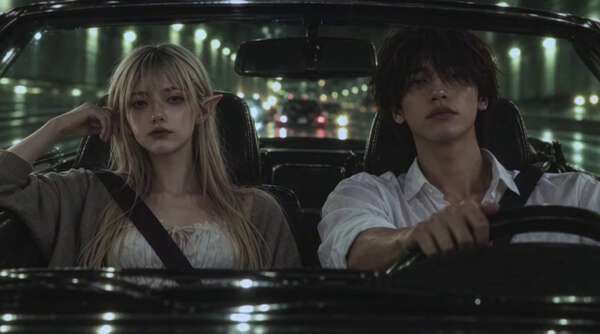
subject_definitions: <Subject 1> is the adult female elf in @Image1 , with the same facial identity, delicate pointed ears, pale natural skin, amber-brown eyes, long light-blond…
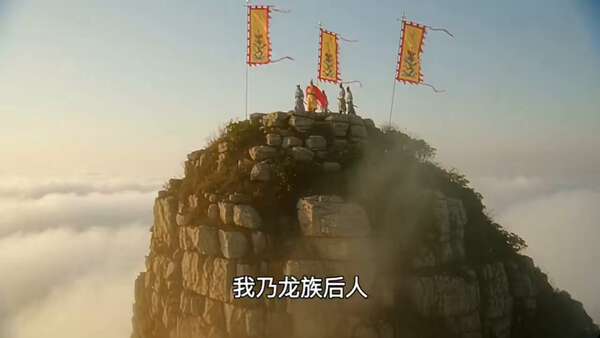
【整体风格】 80 年代香港复古武侠电影质感,胶片颗粒、暖黄怀旧色调、粤语武侠片风格纯音乐配乐,16:9 横屏,总时长 10 秒。 【镜头 1|0-2.5 秒|大全景・仰拍】 云海翻涌的悬崖之巅,身穿金色龙纹长袍的白发老盟主负手而立,披风猎猎,身后旌旗飘扬。老盟主豪迈开口:\"我乃龙族后人,天下万物,皆臣服于我!\" 【镜头 2|2.5-5 秒|中景】 一只…
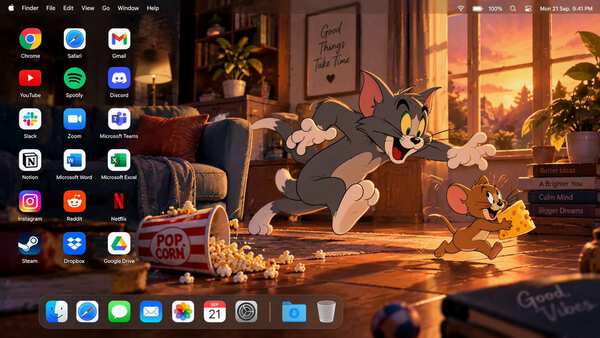
Create a high-end 16:9 macOS desktop screenshot featuring Tom and Jerry as the main characters. Build an original cinematic cartoon living-room environment at sunset, with warm win…
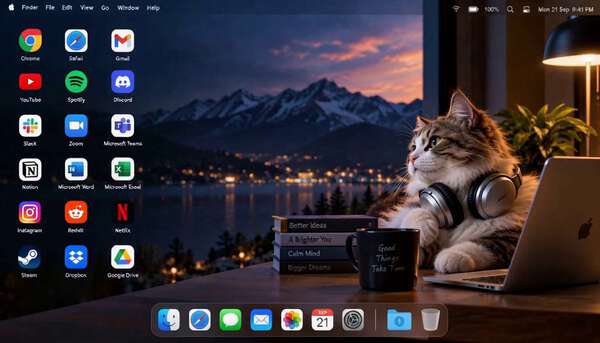
Reference prompt : Create a premium 16:9 macOS desktop environment using the uploaded image as the visual reference for the main subject. Extract the primary subject with clean, na…
A young East Asian girl in fully photorealistic human form, with warm brown eyes, freckles across her nose bridge and cheeks, natural brows, and a confident soft expression. She ha…